Chargebacks are a big problem for merchants. They’re expensive—each chargeback can end up costing you more than double the disputed amount, once you factor in fees and overhead. They’re dangerous, because an excessive chargeback ratio can cause your merchant account to be terminated.
They’re also getting worse. In recent years, 51% of merchants have reported an increase in chargebacks. The total cost of chargebacks was estimated to be $118 billion in 2023.
Chargeback problems don’t disappear on their own, and merchants can’t afford to simply write them off as a cost of doing business. To protect your revenue, your merchant account, and your customer relationships, you need to understand how the chargeback process works and how to determine the root causes of your chargebacks. Only then can you put an effective chargeback management strategy into place.
A chargeback occurs when an issuing bank reverses a card transaction because it is fraudulent, erroneous, or otherwise unauthorized. Cardholders in the United States have the legal right to contact their bank and receive a chargeback when they wish to dispute a transaction for one of these reasons.
Many chargebacks occur when a cardholder sees a charge on their bank statement that they don’t recognize, or when they purchase goods or services from a merchant and never receive what they paid for.
Chargebacks based on valid claims of fraud or non-delivery are always legitimate, but sometimes cardholders will make false claims to obtain a chargeback, either mistakenly or on purpose.
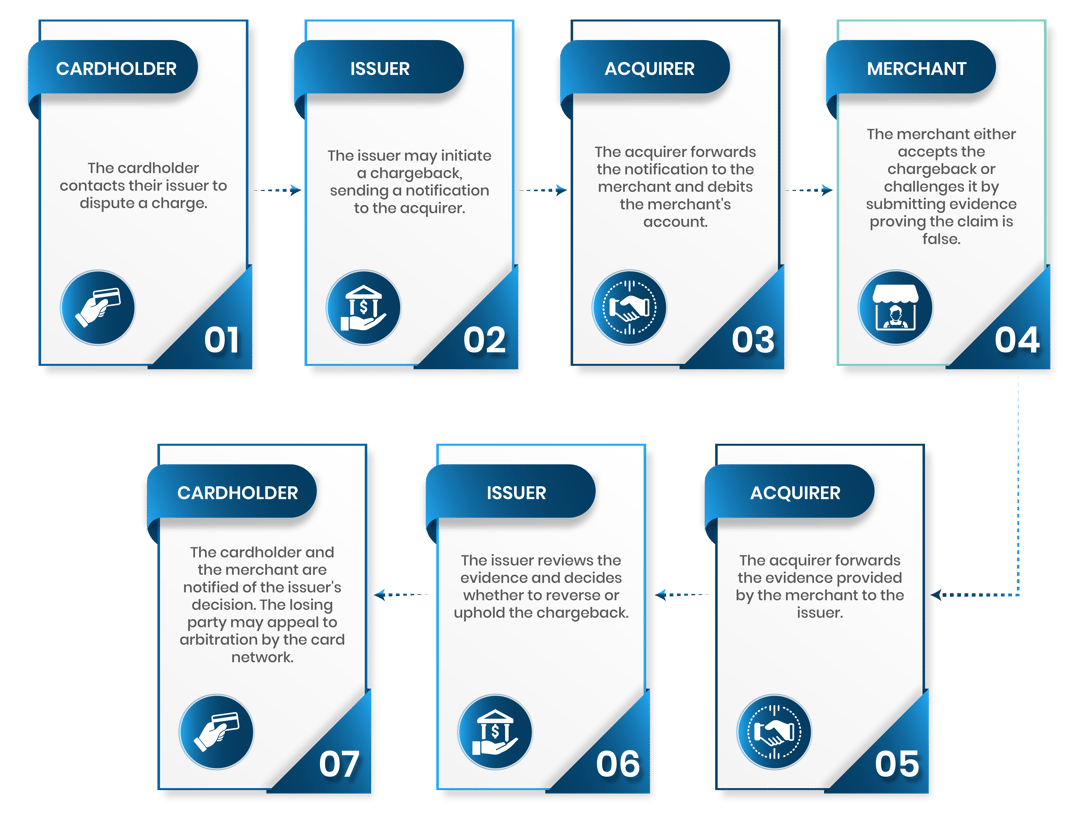
The chargeback process involves many steps, and can vary slightly depending on which banks and card networks are involved. The parties involved are the cardholder, the cardholder’s issuing bank, the merchant, and the merchant’s acquiring bank. If the merchant has hired a chargeback representment firm, they will be involved as well.
Here’s how the basic chargeback process works:

Merchants bear the brunt of chargebacks’ financial impact. By default, merchants are liable for chargebacks. That means that when a chargeback occurs, the funds are taken out of the merchant account and returned to the cardholder. Even though both the merchant and the cardholder may be victims of fraud, it is the merchant who ends up paying for it.
With every chargeback, the merchant loses the transaction amount as well as any merchandise or services already delivered. Merchants also get hit with chargeback fees by their acquirers and processors, which can be anywhere from $5 to as much as $50 for high-risk merchants.
Loss of revenue is always a huge concern, but chargebacks can pose an even more immediate existential threat. Your chargeback ratio is tracked by your acquirer, and merchants who exceed acceptable chargeback thresholds can suffer severe penalties.
Loss of revenue is always a huge concern, but chargebacks can pose an even more immediate existential threat.
Nobody participating in the payments ecosystem in good faith likes to see chargebacks. They represent either criminal fraud or breakdowns in merchant and customer relations, creating bad experiences and undermining confidence in the system. To keep chargeback rates down, the card networks task acquirers with tracking rates and enforcing mitigation protocols for merchants whose chargeback ratios exceed acceptable thresholds.
Mitigation efforts can involve paying fees and dealing with new transaction processing limits until your chargeback ratio gets back to normal levels. Chargeback ratios are calculated by dividing the total number of chargebacks per month by the merchant’s total number of transactions for the same time period. For example, a merchant that has five chargebacks in February on a total of 500 transactions would have a 1% chargeback ratio for the month.
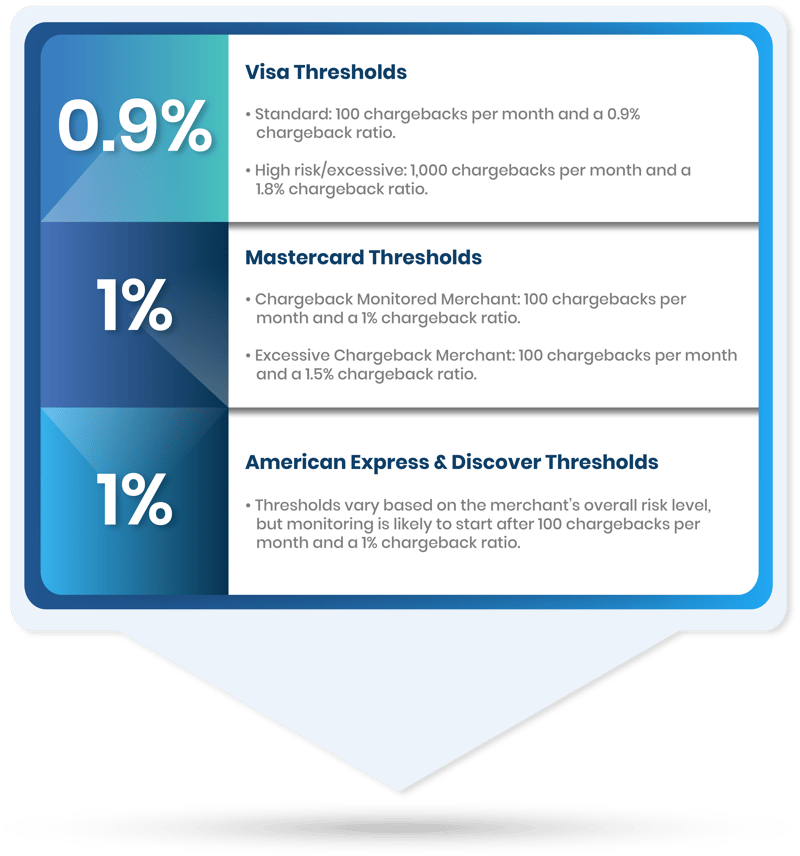
These thresholds are designed to ensure merchants are operating fairly and honestly and are not cheating their customers or colluding with fraudsters. Excessive chargeback thresholds vary by card network but are typically around 1%.
Merchants who exceed their thresholds for too long and do not improve with mitigation efforts may have their merchant accounts terminated. When this happens, they may no longer be able to open a new merchant account with the same business ID, or may be limited to opening accounts with expensive “high risk” payment processors.
These thresholds are designed to ensure merchants are operating fairly and honestly and are not cheating their customers or colluding with fraudsters.
Here are the thresholds for each card network:

For merchants, there are three main categories of chargebacks: true fraud, friendly fraud, and merchant error.
True fraud chargebacks result from the use of stolen credit cards. Payment credentials can be stolen directly from individuals, obtained through data breaches, or hijacked with identity theft or account takeover attacks. Whatever the origin, true fraud means that the charge was made by a third party without the cardholder’s knowledge or authorization. True fraud chargebacks, when valid, must be accepted.
Friendly fraud or first-party misuse chargebacks are chargebacks that are based on false, invalid, or erroneous claims. Cardholders may engage in friendly fraud when they have a conflict with the merchant, experience buyer’s remorse, or are genuinely confused or forgetful about a transaction. Friendly fraud also occurs when cardholders dispute charges made by family members who were allowed to access their card. Friendly fraud chargebacks are illegitimate by definition and can be fought and overturned through chargeback representment.
Merchant error chargebacks involve billing errors, improper transaction processing, shipping mishaps, and other mistakes that might occur on the merchant’s end. Examples include duplicating charges, processing the wrong transaction amount, or failing to process a refund. In theory, once you understand the cause of a particular merchant error chargeback, you should be able to prevent it from reoccurring.
Chargebacks from all three categories can show up under any number of different chargeback reason codes. A reason code is an alphanumeric code that explains the reason behind the dispute. Each card network—Visa, Mastercard, American Express, and Discover—has their own set of unique reason codes. Reason codes are the first key to understanding the root causes underlying your chargebacks. They also show how to fight them and prevent similar disputes in the future. Just keep in mind that they can be deceiving—they represent the issuing bank’s best understanding of the cardholder’s claims, which may not be factual in cases of friendly fraud. To find out more about any chargeback reason code, including what it means, what causes it, and how to fight and prevent it, you can search our Chargeback Reason Code Database.
Reason codes are the first key to understanding the root causes underlying your chargebacks.
There are hundreds of scenarios that might lead to a cardholder dispute, but most chargebacks occur for predictable reasons.
When it comes to legitimate chargebacks, true fraud represents the largest single category. Roughly 30% of all chargebacks involve claims of stolen credit card information, and these claims are far more common in e-commerce. The introduction of the EMV chip—and the shift in liability that motivated its adoption—has made card-present fraud much more difficult.
Fulfilment issues are another major cause of chargebacks, with customers claiming their order never arrived in 24% of disputes and claiming the wrong product was delivered in 15%. In theory, these should only be valid chargebacks if the merchant refused to resolve them. Unfortunately, however, cardholders aren’t always honest with their banks when requesting a chargeback, and the reasons they give for disputing a charge can’t always be trusted.
The alarming truth is that more than three quarters of all chargebacks filed may be attributable to friendly fraud. Many instances of friendly fraud are deliberate attempts at obtaining goods for free, but friendly fraud can also occur because of confusing merchant descriptors, difficult cancellation processes for subscription services, defective products, and long delays in processing refunds.
Another frequent cause of chargebacks is affiliate fraud. When merchants enter into affiliate marketing programs and don’t vet their affiliates, unethical affiliates may post false charges to boost their income before cashing out, leaving the merchant stuck with the chargebacks before they even notice what’s happening. In some industries, as many as 10 to 60% of chargebacks may be affiliate-related.
Finally, beware of poor customer service. Understaffing, long hold times, slow email response, and inefficient operations can prevent customers from resolving their issues directly with you, leading them to opt for the chargeback process as the faster alternative. Unsatisfactory customer service can be an underlying root cause for 10 to 30% of all chargebacks.
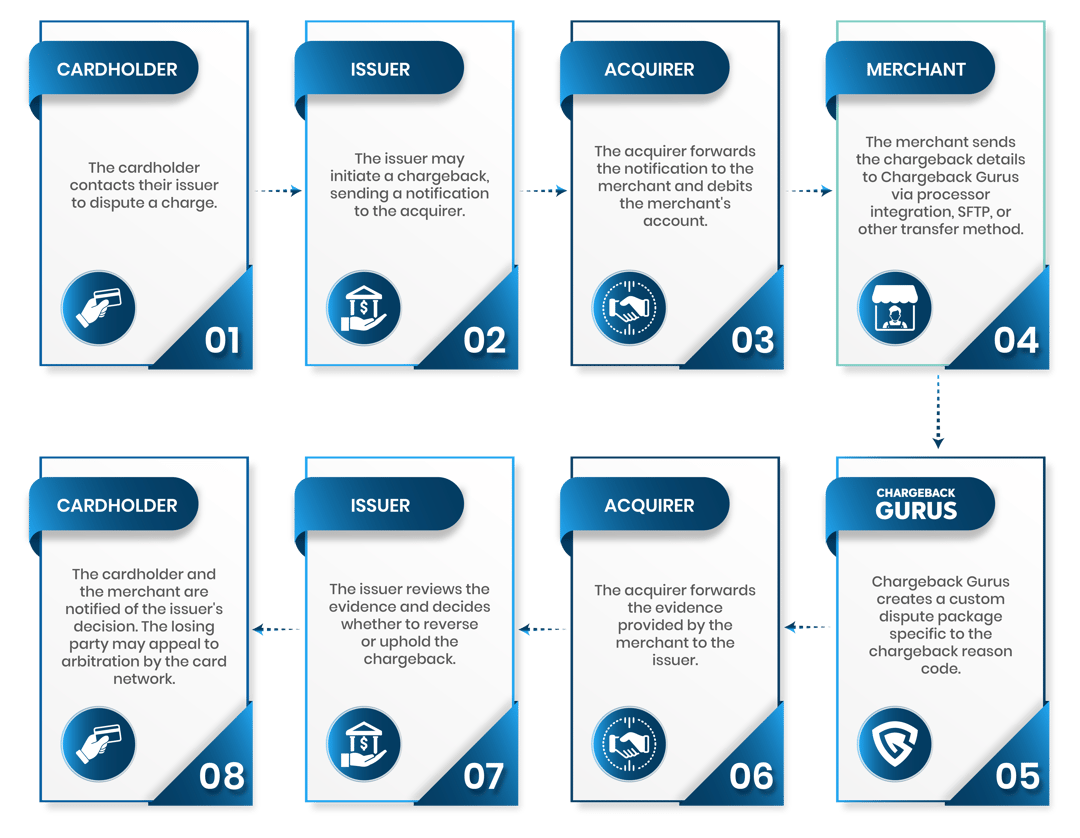
Just as cardholders have the right to dispute invalid charges, merchants have the right to dispute illegitimate chargebacks. When a merchant knows that they have met their obligation to the customer, delivered the goods and services that were purchased, and upheld the terms of their sale agreement—and, most crucially, have proof of all this—they can fight the chargeback and recover their lost revenue. This process is called chargeback representment.
Here’s what the chargeback representment process looks like:

Why (and when) should merchants fight chargebacks?
Merchants should fight chargebacks because friendly fraud is rampant and costly, and because they can recover a significant portion of their lost revenue. Up to 81% of cardholders admit to disputing transactions simply because it’s a convenient way to get their money back, and many of them will happily become repeat offenders if merchants fail to defend themselves. Representment sends an important message that you’re not an easy target. However, it’s important to pick your battles. Fighting legitimate chargebacks is a waste of time. You should only fight a chargeback after you have analyzed it and determined that you have documented proof that refutes the claim.
What is required for a successful chargeback representment?
Three elements are required if you hope to reverse a chargeback:
- Compelling evidence - You must have documents that address the substance of the claim and prove your case. Each chargeback reason code has specific standards for what evidence can be used against it, so always look up the reason code to determine what you need.
Only about six out of ten merchants ever attempt to fight their chargebacks, and for those who do, the average win rate is only 17.4%. With the right kind of guidance and support, merchants can optimize their representment processes to realize much higher win rates.
Note: Source on 17.4% average win rate is MRC 2024 Global eCommerce Payments & Fraud Report.
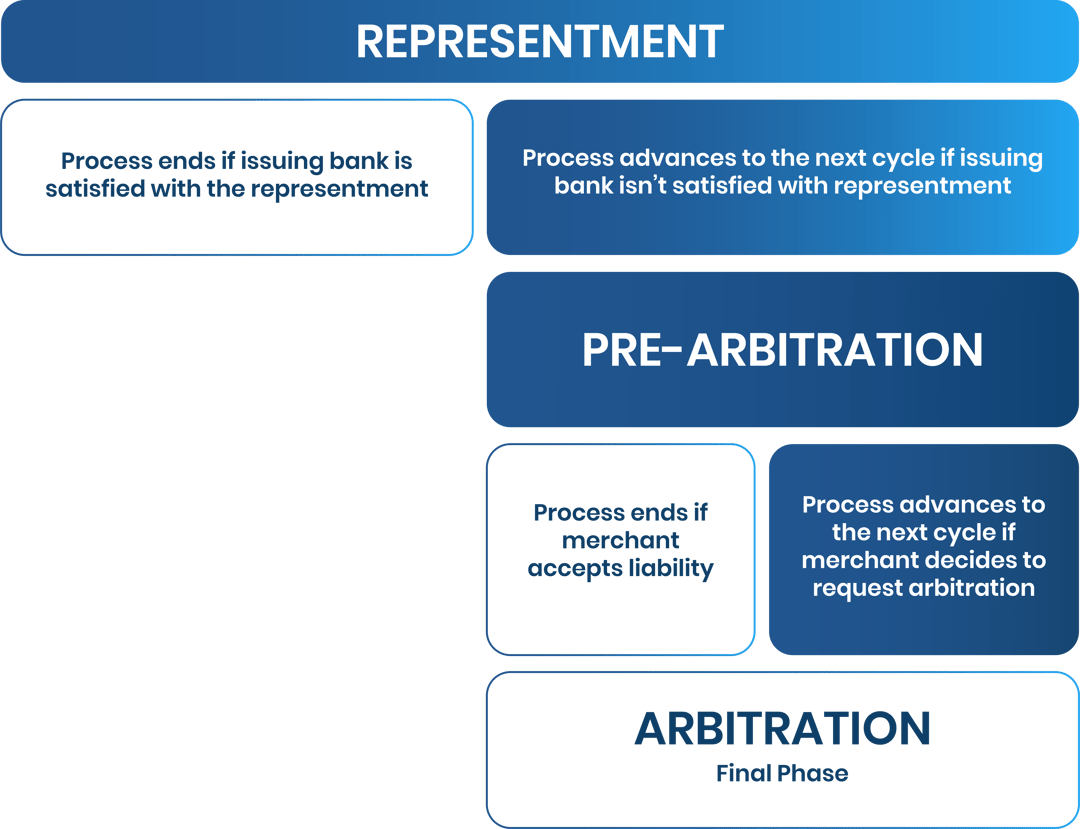
What are pre-arbitration and arbitration?
When the issuer and acquirer cannot reach a final decision on a contested chargeback on their own, any of the parties involved can request a final arbitration by the card network. Pre-arbitration is the last chance for the merchant or issuer to accept liability for the dispute before arbitration.
In arbitration, the burden of proof is once again on the merchant to provide evidence that debunks the dispute claim. Arbitration isn’t cheap—there are lots of fees that kick in here. Mastercard, for example, charges a $150 filing fee, a $250 administrative fee, a $150 withdrawal fee, and a $100 technical fee. Arbitration is best avoided.

Can all chargebacks be prevented?
No merchant has discovered the secret to avoiding all fraud and human error, so chargebacks will never be 100% preventable. However, by employing a chargeback strategy informed by experience, analysis, and tested methodologies, you can minimize preventable chargebacks and devote the majority of your chargeback management efforts to fighting friendly fraud. Every merchant is unique, and it can be helpful to work with a chargeback management firm to determine your specific vulnerabilities and root causes.
However, there are some universal tips for avoiding disputes:
The state of chargebacks is always in motion. Technology changes, fraudsters adapt and evolve, card networks hand down new rules and regulations, and the cycle repeats. When chargebacks are getting the best of you, it helps to have expert assistance at your side to walk you through the changes, analyze your raw data, and help you come up with policies and tactics that strike at the root of your problems. With the right strategy, the right tools, and the right team supporting you, you can win back the revenue you’ve been losing to chargebacks, protect your merchant account, and focus on doing what merchants do best—making customers happy.
With the right strategy, the right tools, and the right team supporting you, you can win back the revenue you’ve been losing.
About Chargeback Gurus www.chargebackgurus.com
Chargeback Gurus helps your business protect and recover more lost revenue by providing innovative chargeback management solutions, leveraging AI, data science, advanced analytics and deep industry expertise.
By understanding our clients’ needs and fully aligning with their goals, we help them reduce chargebacks and increase recovery rates to maximize revenue. Our technology solutions combine powerful data science with deep industry expertise to deliver hundreds of millions of dollars in recovered revenue to our clients.
Schedule a call with one of our chargeback experts
© 2025 Chargeback Gurus ®. All rights reserved.