Data-Driven Chargeback Representment

Current Trends
Every business that accepts credit cards for payment must have a plan for dealing with chargebacks. They affect businesses of every size and industry, and their numbers keep growing every year. 
The scale of the problem extends beyond the number of disputes alone. In a study by Mastercard and Datos Insights, the average chargeback amount was $94 across the four countries surveyed and $110 in the United States.1
Changes in the way consumers file disputes are also increasing the pressure on merchants. The same study found that self-service digital dispute intake led to 30% to 40% higher dispute volumes in the United States.
Mobile and online banking make it easier for cardholders to initiate disputes, which can reduce the opportunity for merchants to resolve transaction confusion or service issues before a chargeback is filed. A report by Mastercard and Javelin Research found that in 75% of disputes, cardholders bypassed the merchant and went directly to their issuing bank.2
Currently, many merchants fail to achieve effective revenue recovery from their chargeback management efforts. According to a survey by Javelin Strategy & Research, 35% of large merchants find chargeback management “very challenging” or “severely challenging.”2
Merchants have cited a variety of challenges they face in managing chargebacks, including insufficient or inexperienced staff, the complexity of card network rules, low recovery rates, illogical reason codes, and inconsistent representment outcomes.
Effective chargeback management requires a consistent way to separate legitimate claims from recoverable revenue, identify the evidence that performs best in each situation, and recognize patterns that point to preventable problems. Chargeback data provides the foundation for making those decisions.
Sources1: Datos Insights, Mastercard, “The Chargeback Window of Opportunity,” (2025)
Sources2: Javelin Strategy & Research, Mastercard, “Chargebacks: The Case for Coordination,” (2026)
Descriptive Analytics
Descriptive analytics aggregates data and uses statistical analysis to uncover trends and patterns. The primary purpose of descriptive analysis is to represent clearly what has happened in the past. It can help merchants not only maximize their recovery rate but also identify the root causes of their chargebacks and find ways to prevent them.
Tracking metrics such as chargeback reason codes, transaction values, lag time, and root causes allows merchants and partners like Chargeback Gurus to discover patterns and trends over time.
Reason Code Analysis
The reason code is the most relevant data point in any chargeback, as it indicates exactly what evidence will be required to refute it. It also allows merchants to categorize, quantify, and track chargebacks by type. Transactions reported as fraudulent account for the largest share of chargebacks, representing the primary driver of dispute-related losses.
“Cancelled Merchandise/Services” and “Merchandise/Services Not Received” are the next most significant reason codes, indicating opportunities to improve cancellation processes, fulfillment tracking, and customer communication.
By identifying reason code trends, organizations can improve fraud prevention, operational efficiency, and customer experience. Analyzing the win/loss ratio for different reason codes can also help merchants discover if there are certain chargeback categories they aren’t fighting effectively.
Keep in mind that reason codes aren’t always the real reason behind the chargeback. Banks tend to take the cardholder’s claim at face value and match it to the closest applicable reason code.
By combining data about the root causes of chargebacks with the reason codes attached to them, we can gain a greater understanding of the chargebacks a merchant receives.

Not all chargebacks are legitimate, and merchants suffer a great deal due to illegitimate friendly fraud chargebacks. While chargebacks are an appropriate remedy for cases of true fraud, some buyers abuse the dispute process to commit fraud themselves. Merchants must fight these chargebacks with evidence disproving the cardholder’s claim.
“Cancelled Recurring Transaction” and “Merchandise/Services Not Received” are the leading reason code categories for friendly fraud, indicating that subscription-related disputes and fulfillment concerns are the most common sources of illegitimate chargebacks.
Chargeback Price Point Analysis
A chargeback price point analysis identifies the transaction value segments that are the primary drivers of dispute volume and financial losses.
Grouping chargebacks across different price bands can help merchants uncover factors such as increased fraud exposure in high-value transactions, higher customer dispute rates in specific product categories, or operational issues affecting certain transaction ranges.

The analysis reveals whether chargebacks are driven by a large number of low-value disputes or a smaller number of high-impact transactions, enabling more targeted investigations. Understanding these patterns allows organizations to implement value-based fraud controls, optimize authorization strategies, and address process gaps contributing to elevated chargeback risk.
Chargeback Lag Time
Chargeback lag time is a measurement of the time between when the original transaction took place and when it was disputed. Monitoring deviations from normal chargeback lag patterns can help organizations detect operational issues, processing delays, new fraud attacks, or changes in customer dispute behavior. 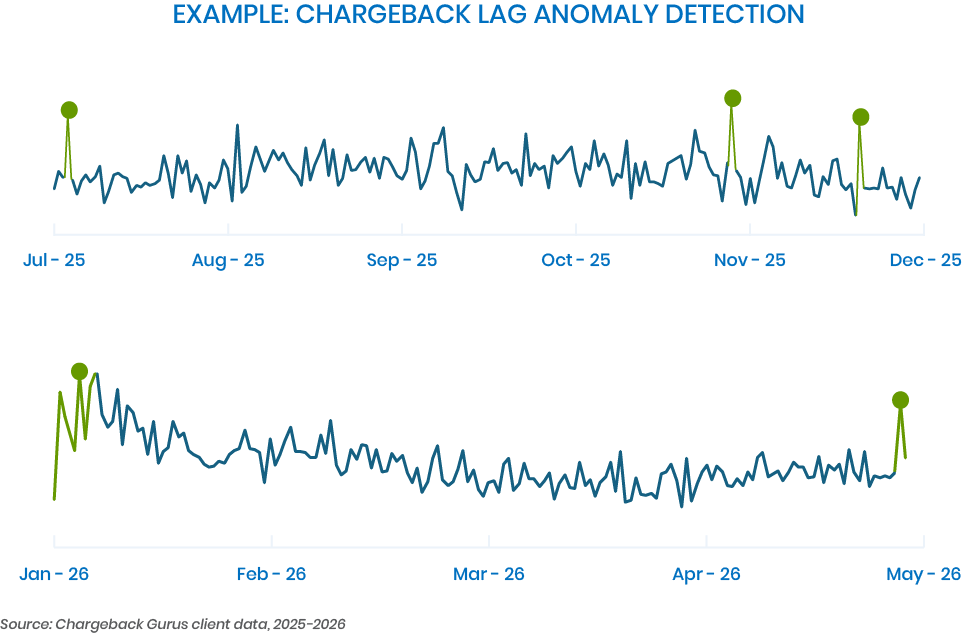
Early identification of these anomalies enables proactive investigation and corrective action before they significantly impact chargeback volumes and financial performance. For businesses with seasonal trends, anomaly detection helps distinguish expected fluctuation patterns from genuine abnormal events that require attention.
Leveraging Descriptive Analytics
When fighting a chargeback through representment, merchants should determine the legitimacy of the chargeback and evaluate the strength of the evidence they would be able to present. They should also take a look at their win/loss ratio in similar cases.
If a merchant loses frequently even after submitting compelling evidence, it may be due to the processor or issuer having very specific requirements that the merchant often fails to meet. The representment package for a given chargeback should ideally be tailored to the specific issuer receiving it.
An individual merchant may not have sufficient data on any given issuer to draw conclusions, which is why Chargeback Gurus leverages anonymized data from across its client base to identify patterns that can help improve representment outcomes.
Analyzing chargeback data can also show how merchants can improve their business processes to prevent certain types of chargebacks, especially those caused by merchant error. When a merchant fails to issue a refund for a legitimate issue, especially if the customer contacted the merchant and didn’t receive a response, a chargeback will often result.
Insufficient fraud prevention tools (AVS, CVV matching, risk scoring, etc.) and processing errors such as duplicate charges can also lead to legitimate chargebacks. Once again, these problems can be identified through descriptive analytics, helping merchants improve their business and reduce chargebacks over time.

Chargeback Volume Forecast
CBG uses ensemble machine learning algorithms like Random Forest as well as deep learning networks for sequential/time-series data like Long Short-Term Memory (LSTM) to forecast chargeback volume. 
Chargeback volume forecasting enables businesses to anticipate future dispute trends and proactively allocate the resources required for effective chargeback management.
For businesses with strong seasonal patterns, forecasting helps identify periods when chargebacks are likely to increase due to peak sales events, promotional campaigns, holidays, or subscription renewal cycles.
Forecasting also helps organizations stay within card network chargeback thresholds by implementing preventive measures before peak periods.
Conclusion
Today’s dispute environment is a challenging one for merchants. More consumers than ever are aware of the power of credit card disputes. Tips for successfully disputing charges are spread on social media, making it easier than ever to commit friendly fraud. There has even been a rise in “professional refunders” who help buyers commit friendly fraud in exchange for a cut of the transaction amount.
To fight these illegitimate chargebacks, merchants need reliable data analysis that shows which disputes are worth contesting, which evidence is most persuasive, and where their current approach is falling short.
As dispute volumes continue to rise, merchants that leverage chargeback data as a strategic resource will be better positioned to recover revenue, identify preventable losses, and adapt to changes in cardholder behavior.

About Chargeback Gurus
Chargeback Gurus provides chargeback management solutions that help merchants protect and recover more revenue. CBG's AI-orchestrated platform combines sophisticated technologies and deep industry expertise to deliver superior results. To learn more, visit www.chargebackgurus.com


.png?width=88&height=32&name=BBB_ABSeal_H_RVS_7469_US-4256x1542-8b06aa0%20(1).png)

